
Science Units, Symbols and Measures

About this Quiz
Behind every measurement lies a story, and most of them are stranger than the numbers suggest.
Consider the language of science. It's built from a compact set of units and cryptic symbols that describe everything from the flicker of an atom to the pull of a black hole. Two letters can stand in for an element forged in dying stars. A single word can capture the invisible force pressing against every square inch of skin at this very moment.
Here's something worth chewing on. Many chemical symbols have almost nothing to do with the element's English name. That's because the naming convention reaches back to Latin, when scholars catalogued substances in the common academic tongue. So the shorthand for certain metals seems to make no sense at all — until the ancient roots are revealed.
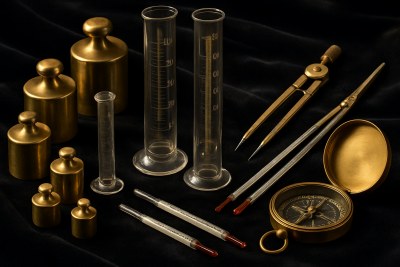
The measurement world also has a taste for honoring its own. A remarkable number of units are named after the scientists who cracked the mysteries they describe. Walk through a physics textbook and it reads like a hall of fame, each name quietly immortalized in lowercase whenever the unit is written down.
Then there's the quiet revolution of 2019. For over a century, the mass standard for the entire planet was a single metal cylinder locked away near Paris. If it gathered dust or lost an atom, the definition of mass itself shifted. Scientists finally freed the world from that fragile lump of metal by tying the standard to something no one can scratch or misplace — a constant baked into the fabric of the universe.
And the system keeps growing. Newer units have been added to describe things the original architects never imagined, from the speed of biological reactions to the crackle of radioactive decay. Why should something as abstract as catalytic activity get its own official unit? Because precision demands it.
The beauty of it all is the elegance. A handful of base units combine and recombine to describe nearly every measurable thing in existence. Master those foundations, and the rest of science starts to click into place.
So how well do the symbols, units, and measures of the scientific world hold up under pressure? There's only one way to find out. Dive into the quiz below and put that knowledge to the test.
Advertisement